
Rapid Transfer Port Factory: Precision Manufacturing for Aseptic Transfer Solutions
2026-10-06
Every aseptic workflow lives or dies by the integrity of its transfer points. A single flawed seal or misaligned port can compromise an entire batch, yet too many facilities still settle for off-the-shelf parts that were never designed for their exact process. At AVM, rapid transfer ports are not just machined—they are precision-manufactured to bridge sterile boundaries with zero compromise. This blog unpacks what actually happens inside a dedicated rapid transfer port factory, from raw alloy selection to final surface finish, and why that level of control matters for your contamination strategy.
Inside the Precision Machining Workflow for Rapid Transfer Ports
Precision machining for rapid transfer ports begins with raw billet selection—typically 316L stainless steel or a high-performance alloy—before a single cutting tool touches the stock. The material is fixtured on a five-axis machining center, where live tooling and tight tolerance control (often within ±0.005 mm) handle the port's mating flange, sealing faces, and interlock recesses in one setup. Tool paths are generated from CAD models that already account for thermal expansion and stress relief, so the finished component holds its geometry after unclamping.
After primary milling and turning, the workflow moves to secondary finishing: deburring, micro-polishing of seal contact areas, and sometimes passivation for corrosion resistance. Each rapid transfer port is then inspected on a coordinate measuring machine against the original print, with special attention to concentricity between the alpha and beta halves and the flatness of the docking face. Non-conforming parts are pulled from the line before assembly, not after final testing.
The final step integrates the machined body with carrier, springs, and gaskets, followed by a leak-tightness check and a cycle test that replicates actual transfer operations. By the time a rapid transfer port leaves the shop floor, it has passed through a traceable sequence of machining, measurement, and functional validation that leaves little room for drift in cleanroom environments.
Why Leak Testing Is Non-Negotiable for Aseptic Transfer Systems
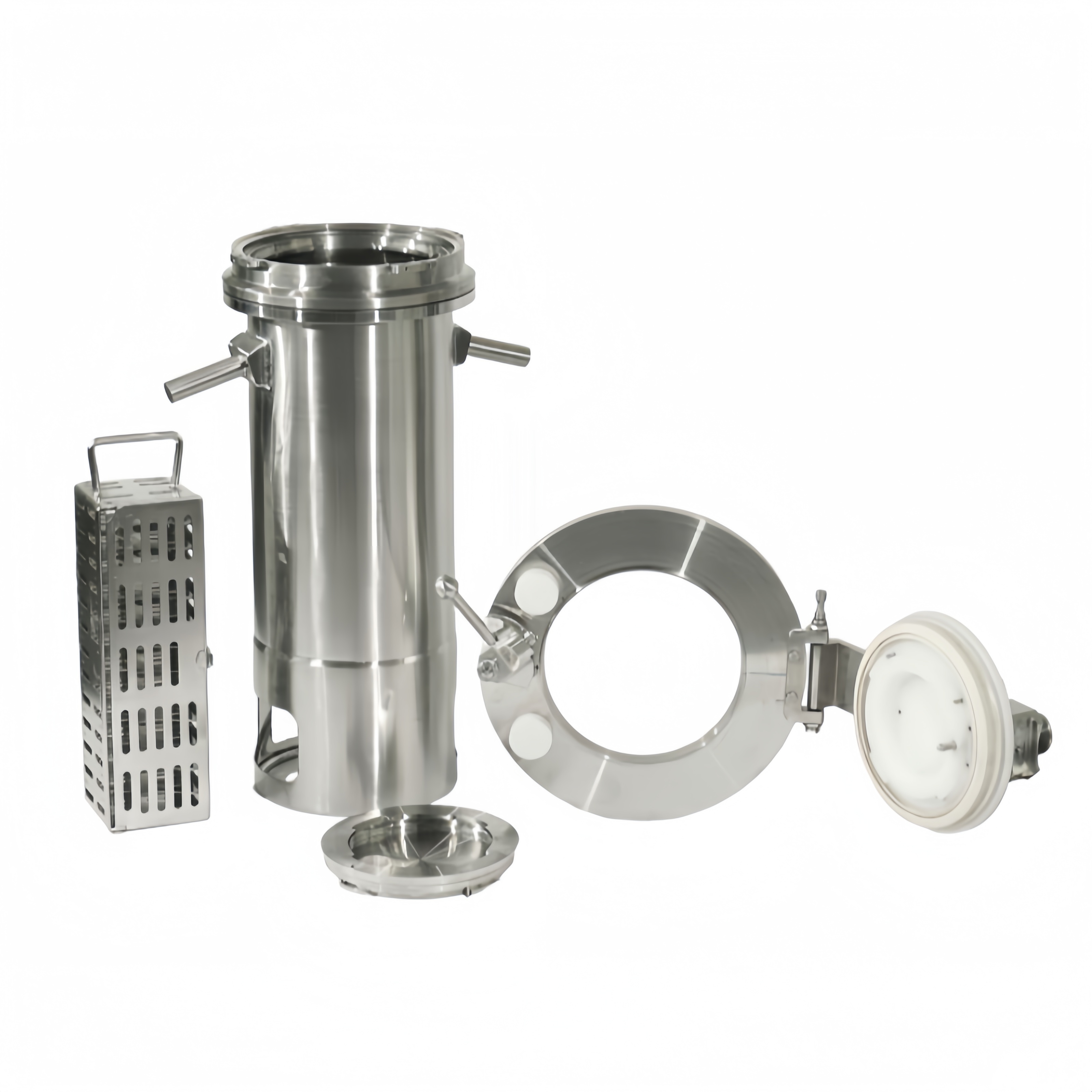
Aseptic transfer systems exist to move materials into or out of a sterile environment without breaking containment. Any breach in that containment—however small—creates a direct pathway for bacteria, spores, or particles. Because these systems rely on seals, gaskets, and mechanical interlocks, wear, misalignment, or damage can go unnoticed during routine use. Leak testing is the only reliable way to confirm that the barrier still performs as designed after every cycle, cleaning procedure, or component change.
The consequences of a failed seal rarely stay local. A single undetected leak can contaminate an entire batch, force a line shutdown, and trigger a costly recall. In pharmaceutical and biotech production, regulators expect documented evidence that transfer ports and isolator gloves maintain integrity over time. Without quantitative leak test data, a facility cannot prove sterility assurance—and no amount of environmental monitoring can compensate for a compromised physical barrier.
Different methods—pressure decay, tracer gas, or vacuum hold—offer varying sensitivity, but the principle remains the same: find the leak before it finds your process. Waiting until product sterility tests come back positive is not a strategy. Integrating leak testing into standard operating procedures turns a potential single point of failure into a controlled, verifiable step. That shift from assumption to measurement is what makes sterile manufacturing defensible.
Material Choices That Extend the Life of Cleanroom Transfer Ports
Selecting the right substrate for a transfer port often comes down to how well it shrugs off repeated exposure to cleaning agents. Electropolished 316L stainless steel remains a workhorse because its surface finish limits crevice nucleation and makes residue easy to wipe away without scratching. In facilities that use vaporized hydrogen peroxide or chlorine dioxide, this choice pays off over years, since the oxide layer resists pitting far better than standard 304 or coated carbon steel.
Gaskets and view panels deserve just as much scrutiny as the metal frame. Silicone or EPDM seals with low extractables hold their elasticity after hundreds of wipe-down cycles, while tempered or laminated glass with a chemically resistant interlayer prevents hazing that forces early replacement. Pairing these with rounded internal corners and flush welds keeps particulate traps to a minimum, which means less aggressive scrubbing and longer intervals between rebuilds.
Finally, mixed-material interfaces need a deliberate approach. Where stainless meets polymer or aluminum, galvanic isolation and matched thermal expansion coefficients stop micro-cracks from forming at the joints. Using FDA-compliant, non-shedding bushings and avoiding threaded fasteners in the controlled zone further reduces failure points. These small decisions compound, turning a transfer port from a consumable component into a durable part of the cleanroom envelope.
How Dimensional Tolerances Prevent Contamination Risks
In hygienic processing equipment, the gap between two mating surfaces is never truly zero, but tight dimensional tolerances keep it below the threshold where bacteria, spores, or product residue can lodge and survive routine cleaning. A bore-and-shaft pair on a rotary valve, for example, must be held within a few microns; any wider clearance creates a capillary channel that draws fluid and debris inward through surface tension. By specifying tolerances that account for thermal expansion and assembly stress, engineers can prevent these micro-crevices from becoming contamination traps without resorting to excessive interference that would gall or shed particles.
Seal grooves are another place where tolerance drift quietly undermines hygiene. An O-ring groove machined slightly too deep reduces squeeze to the point that the seal loses contact with the mating flange under pressure pulsation, opening a direct path for airborne contaminants or washdown water. Slightly too shallow, and the elastomer extrudes into the clearance gap, generating rubber fines that end up in the product stream. Holding the groove width and depth within a narrow band, along with the flange flatness tolerance, keeps the compressed seal in its optimal range and blocks both liquid ingress and particulate generation.
In single-use systems and sterile connectors, dimensional accuracy is what makes a reliable aseptic connection repeatable across thousands of couplings. A male-female taper that is off by a fraction of a degree may still lock, but it can create an uneven mating line that traps media in a thin annulus. Conversely, a well-controlled taper angle and diameter tolerance ensure that the two halves align concentrically, distribute the clamping force evenly, and leave no hidden void for microbial growth. This design-level control reduces the burden on downstream sterilization and environmental monitoring, because the mechanical interface itself denies contaminants a place to persist.
Custom Port Configurations for Unique Containment Challenges
When standard port layouts fall short, tailoring connection points becomes essential. Every deployment brings its own physical constraints, whether it's a narrow cabinet, an oddly shaped enclosure, or a need to reduce cable clutter without sacrificing accessibility. Rethinking default port positions allows you to route power and data exactly where they're needed, cutting down on adapters and awkward cable bends that can compromise long-term reliability.
A common pitfall is assuming that more ports always means better flexibility. In practice, the placement of each port matters far more than sheer quantity. By mapping out actual workflow patterns and environmental obstacles, you can determine whether a side-mounted low-profile connector outperforms a front-facing bank, or whether a recessed bay prevents accidental disconnects in high-traffic areas. These decisions usually come down to a few inches of clearance or a subtle change in orientation.
The real advantage appears during maintenance and future upgrades. When each port sits in a deliberate, tested location, technicians spend less time fighting with cable management and more time on actual tasks. Small adjustments, such as angling a connector upward for easier blind access or spacing ports to accommodate gloved hands, can remove daily friction that standard designs never address.
From Raw Stock to Sterile-Ready: A Factory Floor Perspective
Walking the floor, the shift starts with pallets of raw stock that still carry the faint smell of the mill. Each bundle gets logged and inspected under the overhead lights before it ever touches a clean bench. It’s not glamorous, but that first visual check and lot-number entry set the tone for everything downstream.
The real pressure comes at the transition into controlled areas. Operators move carts through staged airlocks, swapping outer packaging and re-cleaning wheel casters more often than anyone outside would guess. Sterile-ready here doesn’t mean just running a cycle; it means the material has already been handled, wiped down, and accounted for in a way that lets the autoclave do its job without surprises.
By the end of the shift, what sits in the quarantine bay is not the same raw stock that came through the dock that morning. It has a traceable path, a set of initials on the log, and the quiet confidence that comes from a floor crew that has seen every way a process can drift.
FAQ
We control every step in-house, from CNC milling of 316L stainless steel housings to electropolishing and cleanroom assembly. Tolerances on sealing faces are held within ±0.02 mm, and each port undergoes helium leak testing at 1.5× operating pressure before shipping.
The main body and flanges are machined from solid 316L stainless steel with a final Ra ≤ 0.4 µm surface finish. Sealing elements use platinum-cured silicone or EPDM, while the interlocking mechanism features PTFE-coated wear plates to reduce particle generation.
We use a dual-seal design: a primary radial O-ring on the door and a secondary face gasket on the flange. Every batch is cycle-tested 5,000 times with vacuum decay measurement, and validation reports are included with each shipment.
Yes, we offer custom flange geometries, bolt patterns, and door diameters. Our engineering team reviews your CAD drawings or performs on-site dimensional checks, then produces a 1:1 prototype for fit confirmation before full production.
Our facility is certified to ISO 9001:2015 and ISO 13485:2016. We provide material certificates per EN 10204 3.1, full batch traceability, and cleanroom assembly documentation compliant with GMP Annex 1.
Standard 150 mm and 190 mm ports are typically ready in 4–6 weeks. Custom sizes or special surface treatments add 2–3 weeks. For urgent replacement needs, we keep a small stock of common models that can ship within 72 hours.
We maintain a 10-year spare parts inventory for every serial number. Support includes remote video diagnostics, on-site repair kits with tooling, and annual preventive maintenance contracts with re-certification of leak and cycle performance.
Conclusion
Walk the floor of a rapid transfer port factory and the first thing that strikes you is how much care goes into stock preparation before a single flange is milled. Raw billets are inspected, faced, and stress-relieved, then moved through multi-axis machining centers where bore geometry, sealing faces, and locking grooves are held to tolerances tighter than a human hair. It is not just about hitting numbers on a drawing; every pass of the tool affects how smoothly an alpha-beta port will dock and release under cleanroom conditions. Operators log dimensional checks at each stage, and any drift triggers a tool offset correction immediately. This kind of discipline is what separates a port that simply fits from one that prevents contamination risks in aseptic transfer lines.
Leak testing is not an optional final step here; it is woven into the build. Every assembled port is subjected to pressure decay and tracer gas challenges before it earns a cleanroom release tag. Material selection plays an equally quiet but critical role—316L stainless bodies resist pitting from repeated autoclave cycles, while PEEK or PTFE wear rings keep the locking mechanism smooth after thousands of dockings. For unusual containment challenges, custom port configurations grow out of the same engineering bench: offset flanges, non-standard door swings, or glove-friendly actuator placements are machined and tested as one-off builds, not afterthoughts. From raw stock to a sterile-ready assembly, the factory floor treats each rapid transfer port as a sealed boundary, not just hardware.
Contact Us
Contact Person: Ananda
Email: [email protected]
Tel/WhatsApp: 8619016718200
Website: https://www.wzaomi.com